
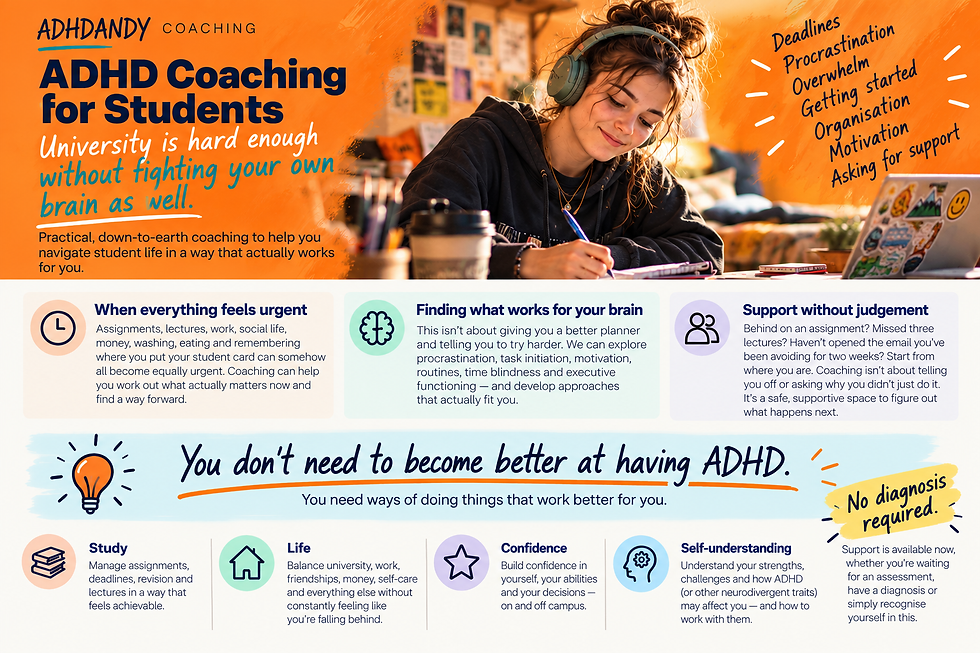
ADHD Coaching For Students
University is hard enough without fighting your own brain as well
University can look like freedom.
No school bell. No parents reminding you what needs doing. Fewer hours actually sitting in classrooms. Weeks to complete an assignment rather than homework due tomorrow.
On paper, that can sound perfect for an ADHD brain.
In reality, all that freedom can come with an enormous amount of self-management.
You have to decide when to work, what to prioritise, how early to start, where you need to be, what you've forgotten, when to eat, when to sleep, when to wash your clothes and whether the email you've been avoiding for eleven days has now become an actual problem.
And somehow, you're supposed to do all of that while studying for a degree.
If you're struggling with it, the answer isn't necessarily that you need to try harder.
It might be that you need to understand what is actually getting in the way.

Sometimes a deadline creates enough urgency to finally get moving, sometimes that works. Until it doesn't.
Coaching isn't about me giving you a better planner and confidently announcing that your problems have been solved.
It's about understanding your version of this pattern and finding approaches that actually work for you.
Sometimes the hardest part is just starting. You know what you need to do. You may even know exactly how to do it.
And yet you still can't bloody start.
That's one of the particularly frustrating things about ADHD. Knowing what needs doing and being able to make yourself do it aren't always the same thing.
From the outside, that can look like procrastination.
From the inside, it can feel like being physically stuck.
So instead of starting with:
“Why haven't you done it?”
I'd much rather start with:
“What's making this difficult to start?”
Maybe the task feels enormous. Maybe the first step isn't clear. Maybe you're worried you won't do it well enough. Maybe it's boring. Maybe you're overwhelmed by everything else.
Or maybe your brain simply isn't cooperating today.
Whatever the answer is, curiosity is usually more useful than criticism.
When “I've got loads of time” suddenly becomes “OH SHIT”
You get an assignment.
It's due in six weeks.
Plenty of time.
Five weeks and six days later, you're sitting in front of a laptop at 2am wondering why you've spent the evening researching something completely unrelated, reorganising your Spotify playlists and suddenly deciding that cleaning the kitchen is critically important.
That isn't because you don't care.
ADHD can affect our perception of time, our ability to initiate tasks, organise competing priorities and generate motivation for things where the consequences still feel somewhere in the future.
University isn't just assignments
Of course, student life isn't only about studying.
There are lectures, seminars, placements, jobs, friendships, relationships, societies, food, money, laundry, emails, appointments and the mysterious administrative portal you were apparently supposed to check three weeks ago.
You might be living away from home for the first time.You might be trying to make friends while simultaneously needing three days to recover from making friends.
You might be discovering that feeding yourself every day requires considerably more planning than anybody warned you about.

You might appear to everybody else to be having a brilliant university experience while privately wondering why you can't seem to manage things that everyone else makes look easy.
You don't have to be failing before you're allowed to find something difficult.
Coaching isn't another person checking your homework
I'm not your lecturer. I'm not going to ask whether you've been good this week.
And I'm definitely not going to sit there looking disappointed because you didn't complete the beautifully colour-coded action plan we discussed last time.
If something we planned didn't happen, that's useful information.
Perhaps the plan was unrealistic. Perhaps something changed. Perhaps the task needed breaking down differently. Perhaps we misunderstood the barrier completely.
The purpose of coaching isn't to make you more compliant.
It's to help you understand yourself well enough to build ways of working that fit you better.

You don't need an ADHD diagnosis
You don't need a diagnostic report to prove that you're finding something difficult..
Perhaps you're diagnosed. Perhaps you're waiting for an assessment. Perhaps somebody has suggested ADHD and you're beginning to recognise yourself in it.
Or perhaps you simply recognise some of the difficulties we're talking about and think coaching might help.
The goal isn't to turn you into the student who gets up at 6am, meditates, meal-preps for seven days and starts every assignment six weeks early.
Unless that's genuinely what you want, in which case crack on.
The goal is to understand how you work.
What helps you start. What makes things harder. What motivates you. What overwhelms you. What environments help. What support you need. What strategies are genuinely useful rather than theoretically perfect.
Because ultimately:
You don't need to become better at having ADHD.
You need ways of doing things that work better for you.
What might we work on?
Every student is different, so there isn't an ADHDAndy student programme where week three is officially “Learn To Use A Calendar.”
Your coaching might involve procrastination, task initiation, deadlines, time blindness, motivation, routines, prioritising, overwhelm, perfectionism, confidence or asking for support.
It might involve figuring out why something keeps going wrong.
It might involve preparing for a difficult conversation with your university.
Or you might arrive saying:
“I've got absolutely no idea. Everything's just a bit fucked.”
Fancy a conversation?
You don't need to arrive knowing what your coaching goals are.
You don't need a beautifully organised explanation of what's going wrong.
And you absolutely don't need to tidy your life up before you're allowed to ask for some help with it.
Book a free 30-minute discovery call and we can have a conversation about what's happening, what you'd like to be different and whether ADHD coaching might be useful.
Brain dumps are welcome, practically encouraged.